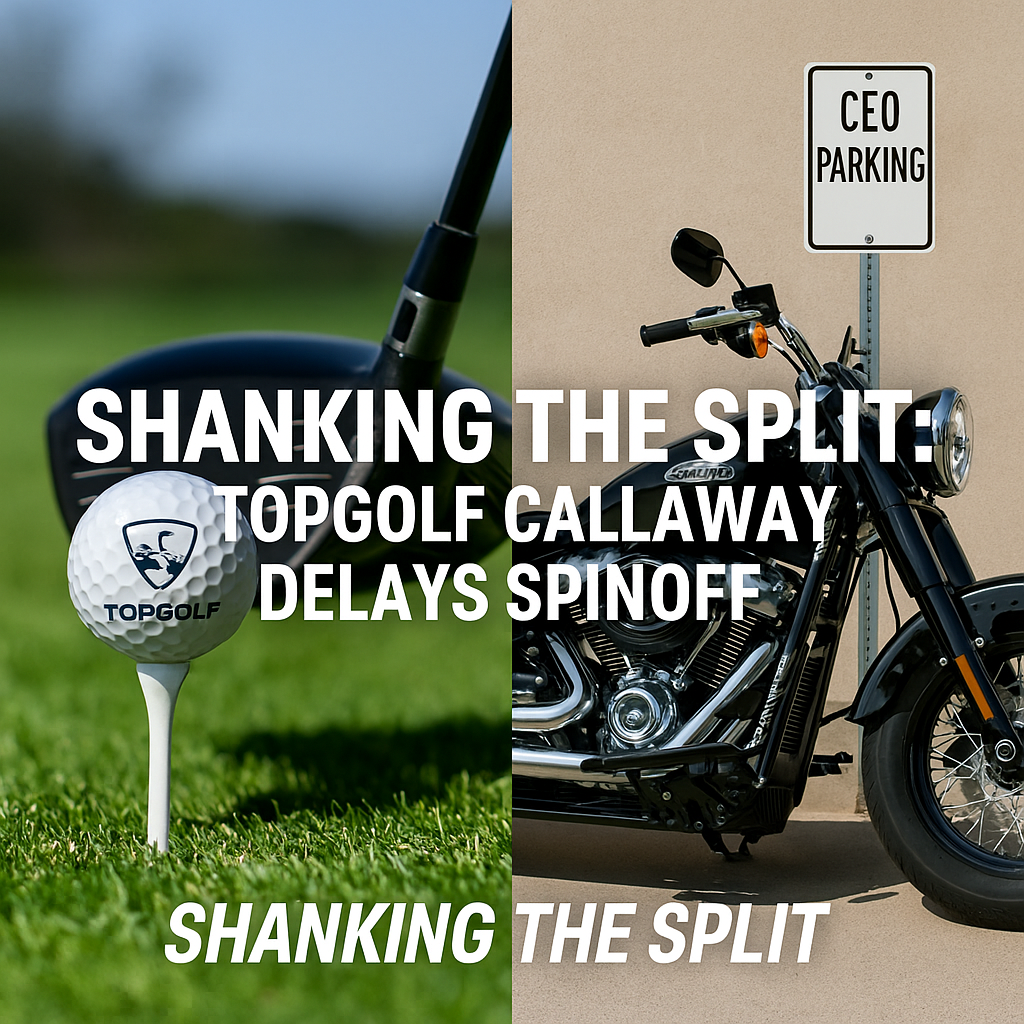
Topgolf Callaway Spinoff Deferred
Topgolf Callaway Brands(MODG) surprised investors this week by announcing it would delay the planned spinoff of its Topgolf entertainment unit, a reversal in both timing and tone from earlier guidance that pointed toward a late-2025 deal. The new expectation? Sometime in 2026, and only after the company recruits a permanent CEO to lead Topgolf forward.
The delay follows the unexpected resignation of Topgolf CEO Artie Starrs, who will be leaving to join Harley-Davidson(HOG) as its next CEO on October 1, 2025. Starrs didn’t just leave the course early—he swapped his driver for a different kind of drive entirely.
A Reversal of a Recent Merger
The move effectively begins to unwind the 2021 merger between Callaway Golf and Topgolf, a deal valued at roughly $2.5 billion at the time. Back then, management pitched the combination as a way to marry equipment expertise with an innovative, high-growth entertainment platform.
For a while, it looked like a hole-in-one: Topgolf’s venue traffic surged post-pandemic, and Callaway’s clubs and balls enjoyed record sales. But cracks appeared—venue build-outs proved costly, labor expenses climbed, and macroeconomic headwinds slowed discretionary spending.
Now, Callaway finds itself reversing course, deciding that each business might perform better as a focused standalone rather than a blended brand.
Why Delay the Separation?
According to Callaway CEO Chip Brewer, leadership stability at Topgolf is essential before the split:
“While our long-term strategy to separate remains intact, it’s critical that we have the right leader in place to guide Topgolf as an independent company from day one.”
Brewer also noted that market conditions—both in terms of capital markets receptivity and operational readiness—played a role in the timing change.
Financial Context
In 2023, Topgolf accounted for roughly $1.7 billion of the company’s $4.2 billion total revenue, making it a major growth driver but also a capital-intensive one. Callaway’s traditional golf equipment and apparel operations remain profitable and less volatile, appealing to a different class of investors than the high-growth, entertainment-focused Topgolf.
By spinning off Topgolf, Callaway hopes to give shareholders a clearer choice: steady cash flows from golf gear and apparel, or growth-oriented returns from a standalone entertainment leader.
What Went Wrong With the Merger
The original deal leaned heavily on cross-marketing synergies—getting Topgolf customers to buy Callaway gear, and vice versa. But operational integration proved challenging: the sales cycles, investment needs, and customer behaviors of a driving-range entertainment venue differ dramatically from those of a golf equipment manufacturer.
What’s more, Topgolf’s growth narrative depended on opening new venues at a rapid clip. That meant high capex, real estate negotiations, and construction timelines—far from the lean, seasonal production cycles of Callaway’s clubs and balls.
Investor Takeaway
The delay will test investor patience. Those looking forward to a pure-play entertainment stock will need to wait at least another year. Meanwhile, Callaway’s management must prove that it can stabilize Topgolf’s leadership, sustain growth, and prepare both businesses for life after separation.
If they succeed, shareholders might get two well-positioned, market-ready companies. If not, the split could become yet another example of a high-profile merger that overpromised and underdelivered.
Spinoff, Strike That, Reverse It
The Topgolf-Callaway split isn’t the first time a supposedly “perfect” corporate pairing has teed off only to slice into the rough. Over the years, we’ve seen several cases where the promised synergies never materialized, and the companies involved decided to undo their own handiwork. Warner Brothers Discovery’s(WBD) upcoming spinoff of Discovery Global is another good example of this.
The lesson? Even in the world of corporate strategy, sometimes the best drive is the one that heads in the opposite direction.